


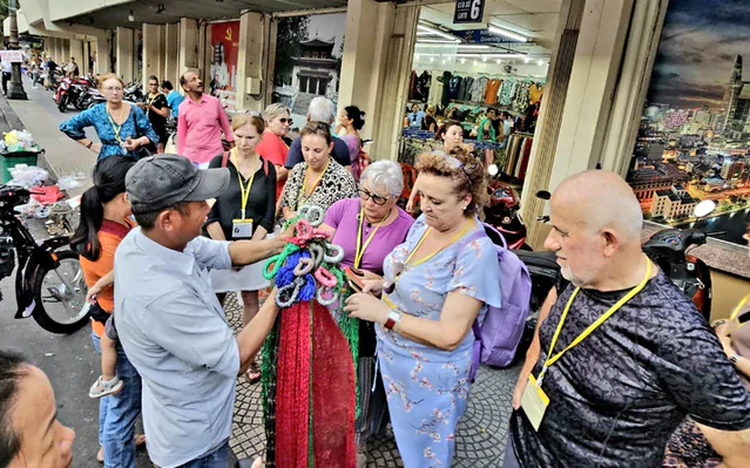
A group of foreign tourists visits Ben Thanh Market in Ho Chi Minh City. Photo: N. Tri / Tuoi Tre
A discussion in the Vietnam Expats Community Facebook group has revealed a range of experiences and opinions, raising a question: when does a higher price for a foreign customer become unfair, and what should visitors do when they think they are being overcharged?
Different prices, different experiences
Several foreigners said they had encountered what they described as a “tourist price” in Vietnam, particularly when buying goods or using services without clearly displayed prices.
One member recalled visiting a state-run museum in downtown Ho Chi Minh City with a Vietnamese friend. His friend was charged 50 U.S. cents, while he had to pay US$4 for admission. He considered the difference unfair.
Others said the practice was not limited to entrance fees. One commenter claimed that foreigners sometimes received less for the same price, citing an example in which local customers were given four scoops of ice cream while tourists received only three.
Prices can also vary considerably depending on the location, even when the product is identical.
Wayne Lamont said a can of Saigon Export beer could cost VND20,000-30,000 ($0.8-1.2) at a small drinking place in an alley in Ho Chi Minh City, but more than VND100,000 ($3.9) just around the corner on Bui Vien Walking Street.
However, another noted that bars and restaurants on Bui Vien charged Vietnamese and foreign customers the same price.
Some commenters suggested that foreigners might be charged more because sellers assume they have deeper pockets.
“If you can get people to pay more you will do it. In Vietnam it's just easier to do it to foreigners because the perception is they have more money,” one member wrote.
But not everyone had experienced such treatment. Jan Van Calenberg said that, in his experience, only a minority of sellers asked foreigners to pay more than locals.
He also shared an example of the opposite kind of experience: several times, local business owners had refused to let him pay for his coffee after they had spent 15 minutes chatting.
One of them explained that the coffee was on the house because they had enjoyed the conversation.
John Gethin shared a similar experience, saying that someone in Vietnam had given him food and refused to accept payment. He had to insist that they take his money.
“Lovely people,” he remarked.
Another foreigner said Vietnamese sellers had several times returned a VND100,000 ($3.9) banknote after he accidentally handed them VND100,000 instead of VND10,000 ($0.39).
Depending on the location, the commenter said he usually trusted sellers to take the correct amount from the cash he laid out.
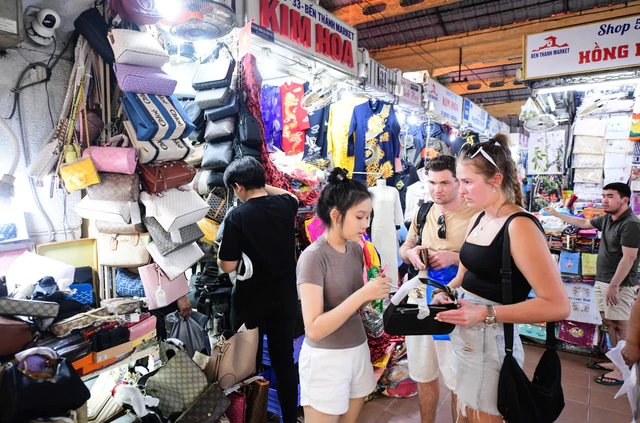
Tourists shop at Ben Thanh Market. Photo: Quang Dinh / Tuoi Tre
Tourist prices not always seen as unfair
While some foreigners objected to being charged more, others said they did not mind paying extra, particularly when the amount remained affordable by their standards or helped local people earn a living.
“I don't mind paying a bit more if it helps the locals,” one commenter said.
Ruth Robert said she was happy to pay higher prices because they were still much cheaper than those back home. She added that Vietnamese people worked hard and that she did not mind paying more.
Others took a more practical approach, saying that a transaction was fair as long as both sides voluntarily agreed on the price.
Kris Wilkins compared buying something in Vietnam to a negotiation, arguing that any price a customer willingly accepted could be considered fair. Those unhappy with an offer could try to negotiate a lower price.
Another foreign resident said he would simply ask for the price and walk away if he considered it unreasonable.
“I’m not there to barter with them. If the price they say is reasonable, I will buy from them,” he wrote.
Some also pointed out that prices vary between businesses in their home countries, so paying more at one shop than at another is not necessarily evidence of discrimination.
Others said visitors should do some research before travelling and learn about local prices rather than automatically assuming they have been ripped off.
Chris Myers from Australia said she and her husband were preparing to return to Vietnam for the sixth time and had never felt ripped off.
She advised visitors to do some research before travelling. Having travelled extensively across Europe and much of Asia, the couple now consider Vietnam their favorite destination for retirement trips.
They typically spend a month in the country and still return home with money left in their pockets.
Know prices before deciding whether to pay
For foreigners living in or visiting Vietnam, the comments suggest that knowing the usual price of a product or service can make a difference.


Some advised newcomers to learn how to bargain, especially when shopping at places where prices are not displayed. If a seller quotes an amount they consider too high, they can make a counteroffer or politely decline and walk away.
Checking prices at several nearby shops, asking local friends for advice and looking for businesses with clearly displayed prices can also help visitors avoid misunderstandings.
At the same time, not every price difference necessarily means a seller is deliberately targeting foreigners. Location, the type of business, the quality or quantity of a product and the willingness of customers to negotiate can all affect what people pay.
Ultimately, foreigners may have different views on what constitutes a fair price. Some are happy to pay more, while others expect to be charged the same as Vietnamese customers for the same goods and services.
The question is not simply whether foreigners sometimes pay more, but whether they know what they are paying for and feel free to accept, negotiate or walk away.
