


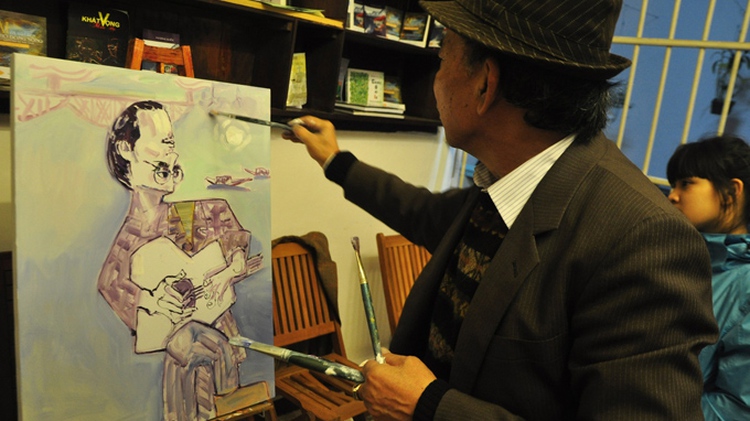
During his recent trip to his home country in early 2014, Vietnamese-American artist Nguyen Dai Giang, who invented upsidedownism, created a portrait of revered composer Trinh Cong Son in the unique style.
Giang’s portrait of Son (1939 – 2001), one of the country’s most venerated composers, is depicted upside down against the background of the Huong River and Truong Tien Bridge, two of Hue’s icons. Giang created the painting right on the very attic where the composer lived during his youthful years in Hue city. The place is now home to his many photos and mementos.
Son’s music is well loved by local and international fans for its haunting melodies and profound lyrics. Several of his iconic songs have been translated and performed in other languages.
Giang’s portrait, which also features Son’s hallmark guitar, chair and coat in the upside-down position, provides a multidimensional, profound look at the late composer.
Local artist Phan Thanh Binh said that though many local artists have portrayed composer Son before, Giang’s portrait of him is indicative of a massive change in the composer’s inner soul.
A great fan of Son’s songs, Giang has painted the composer since 2003. However, he shared that portraying his idol right at his home which nurtured his talents means much more.
Born in 1944 in Hanoi, Giang began painting as early as he was 7 years old. After graduating in Vietnam, he migrated to the US, where he obtained an Associate of Arts degree from the University of Washington in Seattle in 1999.
He once saw a beggar and her baby shivering in the cold, which he considered a profound paradox amidst the wealthy country. It suddenly crossed his mind that paradoxes are omnipresent, even in each individual, and decided that he would adopt them in his later art. In 1993, upsidedownism was born and later recognized in the US.
